

If your cat won’t stop scratching, you might be dealing with cat fleas. These tiny bugs are one of the most common problems cat owners face, and they can turn into a big headache fast if you don’t catch them early.
In this guide, we’ll cover everything you need to know: what cat fleas look like, how to spot the signs cat has fleas, whether cat fleas bite humans, and the most effective cat fleas treatment options available today. By the end, you’ll know exactly how to get rid of cat fleas for good, and how to keep them from coming back.
If your cat has been acting off in other ways too, you might also want to check our guide on why does my cat meow so much, since skin irritation and discomfort from fleas can sometimes make cats more vocal than usual.
What Are Cat Fleas?
Cat fleas (scientifically known as Ctenocephalides felis) are small, wingless, blood-feeding insects. Despite the name, they aren’t picky. They’ll bite dogs, other household pets, and humans if a cat host isn’t available.
Fleas are excellent jumpers. Some species can leap over a hundred times their own body length, which is exactly how they hop from your cat onto your carpet, couch, and bedding. This is a big reason a small flea problem can spiral into a full-blown cat fleas in house infestation within just a couple of weeks.
The Flea Life Cycle
Understanding the flea life cycle helps explain why treatment takes patience. Fleas go through four stages:
- Egg: A single female flea can lay dozens of eggs a day, which fall off your cat and scatter through carpets, furniture, and bedding.
- Larva: Tiny worm-like larvae hatch and hide in dark, protected spots like carpet fibers and baseboard cracks.
- Pupa: Larvae spin cocoons and can stay dormant for weeks, waiting for the right conditions (body heat, movement, vibration) to hatch.
- Adult: Adult fleas emerge, jump onto a host, feed on blood, and start the cycle over again.
This is why experts estimate that the vast majority of a flea population at any given time isn’t even on your pet it’s hiding in your home’s carpets, cracks, and fabric. That’s also why treating only your cat and ignoring your house rarely solves the problem for good.
What Do Cat Fleas Look Like?
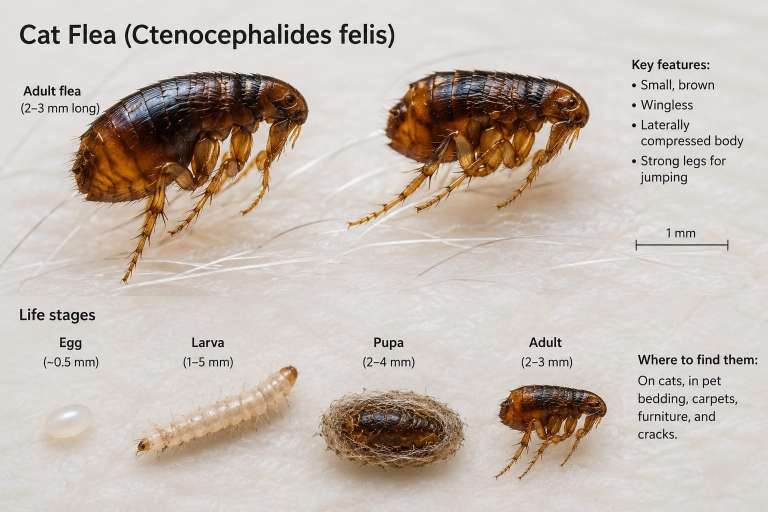
A lot of cat owners ask, “what do cat fleas look like?” It’s a fair question, since these bugs are small and easy to miss at first glance.
Here’s what to look for:
- Small, about 1/8 inch (2–3mm) long roughly the size of a pinhead or a coffee ground
- Reddish-brown to dark brown in color
- A flat, narrow body built for slipping quickly through fur
- Fast, jumpy movement that’s often the first thing owners notice
- Tiny white or cream-colored eggs, about the size of a grain of salt, scattered in the fur or bedding
If you part your cat’s fur near the base of the tail, belly, or neck, you may spot small dark specks moving around. Those are usually adult fleas. You might also see tiny black or brown specks that look like ground pepper or dirt this is “flea dirt,” which is actually flea droppings made of digested blood.
The Simple Comb Test
Here’s an easy way to confirm a flea problem at home. Run a fine-toothed flea comb through your cat’s fur, especially around the neck, lower back, and tail, and tap out whatever you collect onto a damp white paper towel. If the specks turn a reddish-brown color when wet, your cat almost certainly has fleas. This quick test is one of the most reliable ways to confirm what you’re dealing with before starting treatment.
Signs Your Cat Has Fleas
Knowing the signs cat has fleas early can save you a lot of trouble later. Watch out for the following:
- Excessive scratching or biting at the skin Usually the first sign owners notice.
- Hair loss in patches Especially near the tail, lower back, and neck.
- Small red bumps or scabs on the skin Flea bites irritate the skin badly.
- Restlessness Cats with fleas often can’t settle and keep grooming themselves.
- Flea dirt in the fur Tiny black specks that turn red-brown when wet.
- Pale gums In severe infestations, especially in kittens, blood loss can cause anemia.
- Visible fleas In bad cases, you can actually see fleas jumping or crawling on the skin.
- Thickened or scabby skin, particularly around the ears and neck, from constant scratching over time.
If your cat has also started nipping or biting at you more than usual, it could be connected to the irritation and stress fleas cause. We go into more detail on this in our article on why does my cat bite me.
Cat Fleas Symptoms to Watch For
Beyond the obvious itching, cat fleas symptoms can show up in different ways depending on how severe the infestation is.
- Mild cases: light scratching, occasional extra grooming, small scabs
- Moderate cases: hair loss, skin redness, visible flea dirt, restlessness
- Severe cases: pale gums, weakness, weight loss, and in kittens, anemia from blood loss
Some cats are also allergic to flea saliva, a condition called Flea Allergy Dermatitis (FAD). For these cats, even one or two bites can trigger intense itching, scabbing, and skin infections. This is why even a “small” flea problem should never be brushed off.
Do Cat Fleas Bite Humans?
Yes. If you’ve been wondering, do cat fleas bite humans, the answer is a clear yes. Cat fleas bite humans too, especially once an infestation grows large enough that fleas start looking beyond your cat for a blood meal. And if you’re planning ahead for other cat-care decisions, our guides on why do cats throw up their food may also be helpful.
What Do Cat Flea Bites on Humans Look Like?
Cat fleas on humans usually appear as small, red, itchy bumps, often with a red halo around them. They tend to show up in clusters or lines, especially around the ankles and lower legs, since that’s the part of your body closest to carpets and floors where fleas hide.
Common signs of cat fleas bites on people include:
- Small, firm, red bumps
- Intense itching that can last several days
- Bites clustered together or arranged in a line
- Bites concentrated on ankles, feet, and lower legs
Unlike mosquito bites, flea bites tend to stay small and firm rather than puffy, and the itch can linger longer. Try not to scratch too much, since broken skin can lead to infection. An anti-itch cream or antihistamine can help calm things down while the bites heal.
The good news is that cat fleas can’t survive long-term on human skin. We aren’t their ideal host, so while they may bite, they won’t set up permanent residence on you the way they do on your cat.
Other Health Risks Fleas Can Carry
Beyond the itch, fleas can occasionally pass along more serious health issues:
- Tapeworms: If your cat swallows an infected flea while grooming, it can become infected with tapeworm larvae. This can, in rare cases, also affect humans, especially children.
- Bacterial infections: Certain flea-borne bacteria have been linked to illnesses that cause fever, fatigue, and swollen lymph nodes in people who are bitten or scratched by an infested cat.
These risks are uncommon, but they’re one more reason to treat a flea problem quickly rather than letting it linger.
Can Fleas Kill a Cat?
This is a serious question, and unfortunately, the answer is yes in some cases. Can fleas kill a cat? For healthy adult cats, a flea problem is usually just uncomfortable rather than life-threatening. But for kittens, senior cats, or cats with existing health issues, it can become dangerous.
Here’s why:
- Fleas feed on blood, and a heavy infestation can cause serious blood loss
- Significant blood loss can lead to anemia, which is especially dangerous in kittens
- Fleas can transmit tapeworm larvae, which infect cats during grooming
- Severe allergic reactions to flea bites can cause skin infections that spread if left untreated
This is exactly why fast action matters. The sooner you start a proper cat fleas treatment, the safer your cat will be.
How to Get Rid of Cat Fleas: Step-by-Step
Now for the most important part: how to get rid of cat fleas completely. You need a plan that treats your cat, treats your house, and prevents fleas from returning.
Step 1: Treat Your Cat
Start with a proper cat fleas treatment made specifically for cats. Never use a dog flea product on a cat some ingredients that are safe for dogs, like certain concentrations of permethrin, can be toxic and even deadly to cats.
Common options include:
- Topical spot-on treatments: Applied to the skin, usually between the shoulder blades
- Oral flea medications: Prescribed by your vet, working from the inside out
- Flea collars: Useful for ongoing, long-term prevention
- Flea shampoos: Good for an immediate clean-up, though the effect doesn’t last long
- Flea combing: A fine-toothed comb dipped in soapy water after each pass can physically remove and drown fleas, which is a gentle option for kittens too young for chemical treatments
Always check with your vet before starting any treatment, especially for kittens, pregnant cats, or cats with health conditions.
Step 2: Clean Your Home Thoroughly
Since flea eggs fall off your cat constantly and scatter through your house, solving a cat fleas in house problem requires a deep clean, not just a quick vacuum.
- Vacuum carpets, rugs, and furniture daily for at least two to three weeks
- Steam-clean carpets and upholstery if possible, since heat helps kill eggs and larvae
- Wash your cat’s bedding, blankets, and any fabric they touch in hot water
- Pay close attention to cracks in floors and along baseboards, where eggs and larvae like to hide
- Empty or throw away your vacuum bag/canister outside right away so fleas don’t escape back inside
Step 3: Treat Every Pet in the House
If you have more than one pet, treat all of them at the same time, even if only one shows symptoms. Fleas move freely between pets in the same household, so treating just one cat while leaving the dog untreated usually means the problem comes right back.
Step 4: Keep Up a Cat Fleas Treatment at Home Routine
For an ongoing cat fleas treatment at home routine, consistency is everything. A simple weekly plan looks like this:
- Check your cat’s fur weekly with a flea comb
- Vacuum living areas and pet bedding regularly
- Wash pet bedding weekly during an active flea problem
- Keep up monthly preventive treatments even after the fleas seem gone, since eggs and pupae can still be hiding in your home
Flea and Tick Prevention for Cats
Getting rid of fleas is only half the job. Flea and tick prevention for cats is what keeps the problem from coming back, and it’s far easier and cheaper than treating a full infestation later.
Here’s what helps most:
- Use a monthly flea preventive treatment year-round, not just during warmer months. Indoor heating in colder seasons can create ideal breeding conditions for fleas, so the problem isn’t limited to summer.
- Limit your cat’s outdoor time, especially in tall grass or wooded areas where fleas thrive.
- Groom your cat regularly with a flea comb to catch problems early.
- Keep your yard trimmed, since fleas love hiding in tall grass and shady spots.
- Wash pet bedding regularly, even when there’s no visible flea problem.
- Talk to your vet about a year-round prevention plan that also covers ticks, since both parasites often show up in the same environments.
Frequently Asked Questions
Q: Do cat fleas bite humans even if I don’t own a cat?
Fleas mainly need an animal host to complete their life cycle, but they will bite humans opportunistically, especially in homes with a heavy infestation.
Q: How long does cat fleas treatment at home take to work?
Most home treatments start reducing adult fleas within a few days, but because of the flea life cycle, it typically takes two to three weeks of consistent treatment and cleaning to fully clear an infestation.
Q: Can fleas kill a cat if the infestation is caught early?
Catching the problem early makes a fatal outcome very unlikely, even in kittens. The real danger comes from letting a heavy infestation go untreated for weeks.
Q: What do cat fleas look like on a kitten?
The same reddish-brown, fast-moving specks you’d see on an adult cat, though kittens’ skin is more sensitive, so bites and irritation often look more severe.
Final Thoughts
Dealing with cat fleas can feel overwhelming, but with the right plan, you can get your cat back to feeling comfortable again. Focus on treating your cat directly, cleaning your home thoroughly, and sticking to a solid prevention routine going forward.
Cat fleas bites, whether on your cat or on you, are uncomfortable but manageable. The real priority is catching the problem early and following through with a proper cat fleas treatment plan before it gets out of hand.