
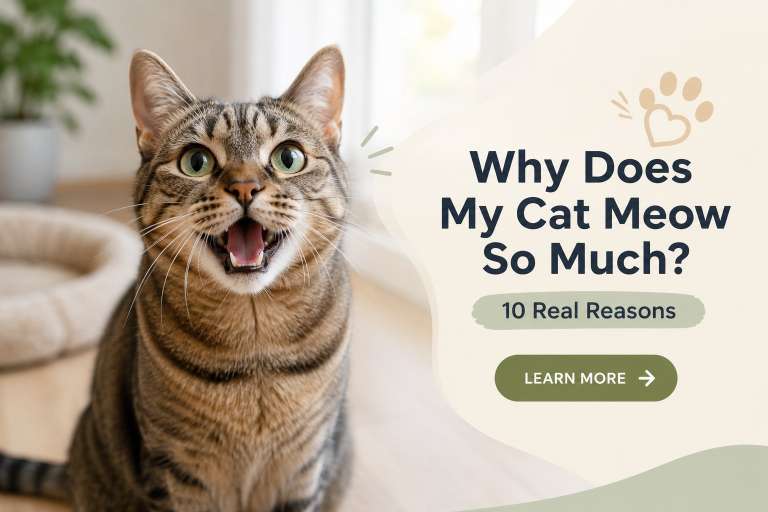
Why does my cat meow so much? If you are reading this at 3 a.m. with a cat staring at you, you are in the right place.
You are not alone. This is one of the most searched questions cat owners type in the middle of the night, right before desperately Googling “how to make my cat stop meowing.” And the answer is not as simple as most articles make it sound.
Your cat is not broken. They are not out to ruin your sleep or your sanity. They are talking to you. The real question is: what are they actually saying?
This guide covers every real reason behind excessive cat meowing, decodes the different types of meows, shows you exactly when to call a vet, and gives you fixes that actually work. By the time you finish reading, you will understand your cat better than most pet owners ever do.
The One Thing About Cat Meowing Most People Do Not Know
Adult cats do not meow at other cats.
Read that again slowly.
When cats interact with each other in the wild, they use body language, scent marking, and other vocalizations. But meowing? That is a behavior cats developed specifically to communicate with humans. It is their version of tapping you on the shoulder and saying, “Hey. I need something.”
So every time your cat meows at you, they are choosing you as their communication partner. They have figured out that you respond to sound, and they are using that knowledge to reach you. The only problem is that we do not always know what they are trying to say. That is exactly what this article fixes.
Why Does My Cat Meow So Much? The 10 Real Reasons
1. Your Cat Is Hungry (Or Thinks They Are)
This is the number one reason behind excessive cat meowing, and it is more complicated than it looks.
If your cat follows you into the kitchen meowing, screams at you at 6 a.m., or goes completely silent the second you fill the bowl, you have a food-motivated cat. Which is basically every cat on the planet.
Here is the part most people do not realize: even a bowl that is half-full can look “empty” to a cat if they can see the bottom. Your cat is not lying. They are just very, very committed to their performance.
What to do:
- Feed at consistent set times so your cat learns the routine
- Use an automatic feeder set to dispense meals overnight so your cat waits by the machine instead of your face
- If your cat acts constantly hungry AND is losing weight, book a vet appointment. This combination points to a medical issue.
2. Your Cat Meows for Attention Because It Works
Here is a hard truth that most cat owners do not want to hear. If you have ever gotten up, looked at your cat, or even said “shhhh” in response to meowing, you have accidentally trained your cat that meowing gets results.
Cats are smart. Frighteningly smart. They figure out very quickly that making noise brings you running. Once that lesson is learned, the meowing gets louder, more frequent, and more persistent over time. They are not being manipulative on purpose. They are just doing what has always worked.
What to do:
- Never reward meowing with attention, even negative attention like telling them to stop
- Wait for a brief moment of silence, then immediately give affection
- Be consistent. This habit takes time to unlearn, but it does work.
3. Cat Meowing From Boredom: The Problem Nobody Talks About Enough
Picture your cat’s day. You leave for work. They sit. They sleep. They stare at the wall. They sleep again. By the time you get home, they have 10 hours of stored-up energy and absolutely nowhere to put it.
Indoor cats suffer from boredom more than most owners realize. That pent-up frustration and mental understimulation comes out in a very specific way: excessive vocalization, especially in the evenings and at night. This is one of the most overlooked causes of a cat that meows constantly.
What to do:
- Put a bird feeder outside a window and give your cat a perch. That is free, live entertainment.
- Rotate toys regularly. Something “new” is always more interesting.
- Try food puzzle feeders that make your cat work for meals.
- A 15-minute play session before bed burns off energy that would otherwise become 3 a.m. noise.
4. Your Cat Is Just Saying Hello
Some cats are social, enthusiastic, and genuinely happy to see you. Every time.
If your cat meows when you come home, chirps at you from across the room, or responds when you talk to them, this is simply how they say hi. It is normal, harmless, and honestly pretty endearing.
This type of meowing is usually short, upbeat, and fades quickly once the greeting is complete. There is nothing to fix here. You just have a cat that likes you.
5. Why Cats Meow When Stressed or Anxious
Cats are animals of routine. They do not handle change gracefully. Moving to a new home, a new baby arriving, a new pet in the house, rearranged furniture, a change in your work schedule: any of these can trigger a cat to meow more as a way of expressing anxiety and discomfort.
The clue is timing. Did the excessive meowing start around the same time as a change in their environment? Is your cat also hiding more, eating less, or over-grooming? That is stress talking.
What to do:
- Create a quiet, consistent safe space your cat can retreat to
- Try pheromone diffusers like Feliway, which release synthetic calming scents
- Keep feeding and play on the same schedule every single day
6. A Dirty Litter Box Is Why Some Cats Meow Constantly
Cats have strong opinions about their bathrooms. Very strong opinions.
Many cats will meow right after using the litter box if it is dirty, or position themselves near it and meow loudly until someone handles the situation. Some cats flat-out refuse a dirty box and meow at the door to go outside instead. They are not being fussy. Clean is a genuine need for cats, not a preference.
The rule: scoop at least once a day, deep-clean weekly. A clean litter box is one of the easiest ways to reduce unnecessary cat vocalization.
7. Your Cat Meows at the Door to Go Outside
If your cat previously had outdoor access and now stays inside, prepare for a protest campaign. It can last weeks.
Cats who are used to outdoor freedom and suddenly confined indoors will meow at doors, scratch at windows, and vocalize their frustration loudly and often. They are not being stubborn. They genuinely miss the stimulation, the smells, and the territory.
What to do:
- Be consistent. Giving in even once resets the clock and teaches them that meowing works.
- Consider building a “catio,” a screened outdoor enclosure, as a safe compromise.
- Enrich the indoor environment with climbing trees, window perches, and hunting-style toys.
8. Cat Yowling Because of Heat or Hormones
If your female cat is unspayed and suddenly meowing like the world is ending, she may be in heat. The sound is not just meowing. It is yowling: a loud, drawn-out, sometimes haunting sound that is hard to describe until you have heard it.
Female cats in heat become extremely vocal, restless, and affectionate. This cycle repeats every 18 to 24 days throughout breeding season and lasts 4 to 10 days each time. Unspayed indoor cats may cycle year-round.
Male cats detect female cats in heat from a surprising distance and will also yowl loudly in response.
The fix: Spay or neuter your cat. This eliminates the hormone-driven vocalization, is better for long-term health, and prevents unwanted litters.
9. Some Cat Breeds Are Naturally More Vocal
Some cats are just talkers. It is in their DNA, and no amount of training fully changes it.
Cat breeds known for excessive vocalization include:
- Siamese cats: The most famous talkers. They will have full conversations with you and seem offended if you do not respond.
- Oriental Shorthairs: Similar to Siamese in personality and volume.
- Burmese cats: Social and vocal, especially with their people.
- Bengal cats: Active, alert, and very communicative.
- Maine Coons: Less loud but very chatty in a soft, chirping, trilling way.
If you have one of these breeds, excessive meowing may simply be your cat expressing themselves. You cannot eliminate it, but you can channel it. These breeds thrive with interactive play, mental stimulation, and lots of engagement.
10. Medical Reasons Your Cat Meows Excessively
This is the one that matters most, and the one that most cat owners check last when they should check it first.
When a cat’s meowing changes suddenly, especially in an older cat, it can be a symptom of an underlying medical condition. Cats instinctively hide signs of pain and illness. Vocalization is often the earliest and only visible clue that something is wrong inside.
Medical conditions that commonly cause excessive cat meowing:
Hyperthyroidism: Extremely common in cats over 7 years old. An overactive thyroid gland speeds up the metabolism, causing weight loss despite a strong appetite, hyperactivity, restlessness, and loud nighttime meowing. Highly treatable once diagnosed.
Cognitive Dysfunction Syndrome (CDS): The feline version of dementia. Older cats become confused and disoriented, especially at night, and cry out because they genuinely do not know where they are. A nightlight near their sleeping spot can reduce nighttime crying significantly.
Kidney Disease: One of the most common conditions in senior cats. Discomfort, nausea, and increased thirst all contribute to vocalization.
Hypertension (High Blood Pressure): Often develops alongside kidney disease or hyperthyroidism. Can cause neurological symptoms and loud, distressed meowing.
Urinary Blockage or UTI: If your cat, especially a male cat, is meowing in or near the litter box and appears to be straining, this is a veterinary emergency. A urinary blockage can be fatal within 24 to 48 hours. Do not wait.
Pain from Any Source: Arthritis, dental disease, an injury, a tumor: any chronic or acute pain can cause a cat to vocalize more, especially when moving, jumping, or being touched.
What Different Cat Meow Sounds Mean: A Translation Guide
Not all meows are equal. Learning to read the tone, pitch, and context changes everything.
| Meow Type | What It Usually Means |
| Short, quick meow | Friendly greeting: “Hey!” |
| Multiple short meows in a row | Very excited greeting: “You are finally home!” |
| Long, drawn-out meow | A demand: “I want something right now.” |
| Low-pitched meow or moan | Complaint or mild discomfort |
| High-pitched, urgent meow | Pain or distress: go to the vet |
| Yowling or howling | Heat cycle, territorial behavior, or medical emergency |
| Chirping or chattering | Watching prey: pure hunting instinct |
| Silent meow (mouth opens, no sound) | A soft, affectionate greeting: the highest compliment a cat gives |
The key is context. Pay attention to what your cat is doing when they meow, who is in the room, what time of day it is, and whether anything has changed. Over time you will learn your specific cat’s vocabulary.
Why Does My Cat Meow So Much at Night? And How to Stop It
Cat meowing at night is its own problem and deserves its own section, because it is the most disruptive and the most fixable.
Why cats meow at night:
Cats are crepuscular animals, meaning they are naturally most active at dawn and dusk. When you are winding down and getting ready for sleep, your cat’s internal clock is saying “adventure time.” This is not personality. It is biology.
Layer on top of that a cat who slept all day, is hungry, is a senior with early cognitive changes, or has learned that nighttime meowing brings you out of the bedroom, and suddenly 3 a.m. is a fully operational concert.
What actually stops cat meowing at night:
1. Play session before bed. A 15-minute wand toy session right before you sleep exhausts your cat physically and satisfies their hunting cycle: hunt, catch, kill, eat, groom, sleep. This sequence is deeply wired into every cat. Use it.
2. Feed right after the play session. A protein-rich meal after play mimics the post-hunt meal and naturally leads to sleep. Timing this correctly can completely change your cat’s nighttime behavior.
3. Use an automatic feeder. Set it to release a small portion at 5 or 6 a.m. Your cat will wait in front of the machine instead of standing on your face.
4. Keep your cat active during the day. A cat that naps 18 hours straight is going to be wired at night. Midday play sessions, puzzle feeders, and window perches spread activity across the day.
5. Add a nightlight for senior cats. Older cats with CDS become disoriented in the dark and cry out because they are genuinely frightened and confused. A small nightlight near their sleeping area helps more than most people expect.
6. Stop responding to the meowing. This is the hardest one. Every time you get up to check on them, you confirm that meowing at 3 a.m. brings results. Consistency over a few weeks breaks the cycle.
When Cat Meowing Means a Vet Visit Right Now
Some meowing is normal. Some is an emergency. Here is how to tell the difference.
Go to the emergency vet immediately if:
- Your male cat is meowing and straining to urinate. This is a urinary blockage. It is fatal without treatment within 24 to 48 hours.
- Your cat is meowing and open-mouth panting. Cats do not pant like dogs. This signals severe pain or a respiratory crisis.
Call your vet and get an appointment within a day or two if:
- The meowing started suddenly with no obvious cause
- Your cat seems to flinch when touched, is limping, or is hiding more than usual
- You notice weight loss, increased thirst, or changes in how much they eat
- An older cat has started meowing at night for the first time
- The sound of the meow has changed in tone or pitch
When in doubt, call your vet. A quick phone consultation is always worth it.
The Angle Nobody Else Is Writing About: Meowing Is a Sign of Trust
Here is something most articles on cat vocalization completely miss.
Cats do not meow at each other. They meow at us. That means every single meow your cat directs at you is a deliberate choice to communicate with you specifically. They have learned that you are responsive, that you listen, and that talking to you sometimes leads to good things.
Your cat’s meowing is not just noise. It is evidence of a relationship.
The goal is never to silence your cat completely. The goal is to understand what they are saying well enough that both of you get what you need. A cat that feels heard, stimulated, and cared for does not need to scream at 3 a.m. to get your attention. They already have it.
Quick Guide: What to Do Based on Your Specific Situation
Cat just started meowing more out of nowhere: See a vet first. Sudden behavioral changes need to be checked medically before anything else.
Cat meows constantly around mealtimes: Set a consistent schedule. Use an automatic feeder. Never reward meowing by giving food when they ask for it.
Cat meows all night: Play session plus a protein meal before bed, automatic feeder for early morning, daytime enrichment to shift the sleep cycle.
Older cat meowing at night: Vet check for hyperthyroidism, CDS, and kidney disease. Add a nightlight. Keep their routine completely predictable.
Cat meows for your attention all day: Stop rewarding it with any response. Reward quiet behavior with affection instead. Be patient.
Chatty breed that just meows a lot: Accept it. Engage with it. Give them mental stimulation and interactive play so the communication has somewhere to go.
Final Word on Excessive Cat Meowing
Your cat is always telling you something. They are telling you they are hungry, bored, lonely, confused, in pain, anxious, or just genuinely thrilled that you walked into the room. The meowing is not the problem. Not understanding it is.
Spend a few days really listening. Notice when it happens, what triggers it, and what makes it stop. You will start to see your cat’s patterns. And those patterns will tell you everything you need to know about what they need from you.
If anything changes suddenly, especially in an older cat, trust your gut and call a vet. Your cat cannot explain in words that something hurts. Their voice is the only tool they have.



One thought on “Why Does My Cat Meow So Much? 10 Real Reasons and What to Do”